Note: Minor spoilers ahead if you haven’t yet but intend to read books in The Stormlight Archive by Brandon Sanderson. This one is likely not going to age well given the state of Taravangian as of Books 4 and 5.
Taravangian is one of the many great characters in the Stormlight Archive. A king who wants to do right by his people, at least according to him. At some point before the events of the series, he asks for a boon from a… erm… deity of sorts, to give him the capacity to save humankind. This boon is granted, in the form of great intelligence and great compassion—but he is also cursed to never have them at the same time. You see, this deity had some ulterior motives that were not immediately obvious, somewhat like trickster gods from mythology.
As a result, Taravangian is very intelligent on certain days (and almost a sociopath, but let’s ignore that for now), and somewhat lacking in intellect (but very compassionate) on others. His intelligence and compassion levels fluctuate day to day, inversely proportional to each other, with extreme days of either being relatively rare. He attempts to cope with this multiple ways—taking daily tests to check his mental state, having systems in place to stop him from making decisions when he’s having an unintelligent day, and so on.
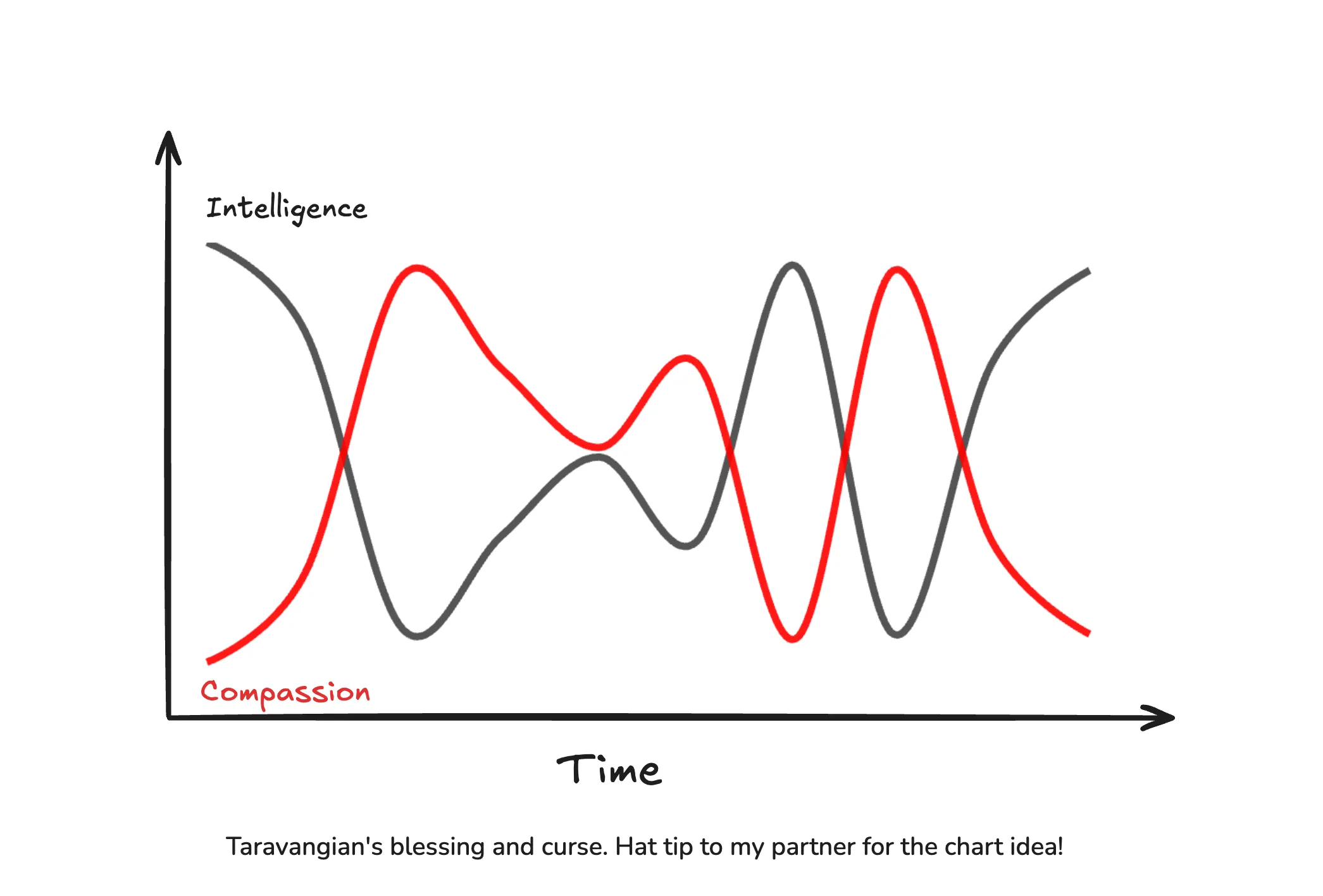
But, the thing I’m interested in, is this: On a day of peak intelligence, he spends his time writing extensive instructions, codes, predictions, and plans across every surface of his bedroom, including inventing hieroglyphics. All of this is later compiled into an epic text called “The Diagram”, which serves as a complex and often cryptic guide for both Taravangian himself and his followers in their efforts to “save humanity”.
It recently struck me that I too can be like Taravangian, feeling like a genius on some days, but really thickheaded on others. At the very least, we all have had good days and bad days. But unlike this blessed king, I didn’t always write stuff down on my best days. I relied almost entirely on my memory for most of my life.
I kept getting told my memory was like a “steel trap” because I could often remember past events or decisions and the reasons behind them. If I couldn’t remember them word for word, I’d at least remember where or how to find the relevant documentation. This often involved combing through emails, chat histories, browser histories, etc. for context or links to documents. I had developed an unwritten standard operating procedure for recall, clunky as it was. The habit of taking notes for myself was never something I kept up, because I thought I could remember everything. And I did not see that there was a problem with that.
A couple of years into my career, I started writing again after I saw my boss taking meeting notes in Evernote (I’m easily influenced, turns out). I would end up going down several rabbit holes of writing apps over the years (as I’m sure many have), and keep pen and paper journals as well. I’m coming to believe that writing is essential to connect the two Taravangian states of self. I find myself needing to refer to the notes I wrote on my “good” days to get me through my “bad” days. This is becoming increasingly obvious to me in a way that it did not before, as I grow older and find my memory letting me down on more often than I would like. Although, there are times when I wonder if it was after I started keeping a journal that my memory started to falter, because sometimes, you write to forget.
More importantly—writing helps me think. Having thoughts in my head is not enough; I need to be able to externalize them somehow to understand them and evaluate them for what they are. It helps me understand myself better, and does wonders for my mental health.
“If you can’t read and write, you can’t think. Your thoughts are dispersed if you don’t know how to read and write. You’ve got to be able to look at your thoughts on paper and discover what a fool you were.” — Ray Bradbury
I remember that I found it very easy to spend a lot of time on “research” (also known as procrastination, in some circles) around how and where to write. I have a “productivity” folder full of bookmarks related to personal knowledge management systems. PARA! Zettelkasten! Commonplace book! Bullet journal! Johnny decimal! It took a while before the obvious hit me—it doesn’t matter. Just write. If a system makes it harder for me to get started putting words to paper or screen, it’s probably not the right one. It was certainly helpful to pick one system to start with—I used the basic bullet journal method when I wanted to go back to paper, and I still try to keep that going for journaling, as there’s something about writing slowly with a pen that feels better for diary-type stuff. Most of my daily note-taking and processing (including writing for this site) is now done using Obsidian—because plain text rules. Hopefully, my notes can serve as a guide for future me, like the Diagram did for poor old (cough) Taravangian.